
How to Get Your Website to Show Up on Google: A Complete SEO Guide
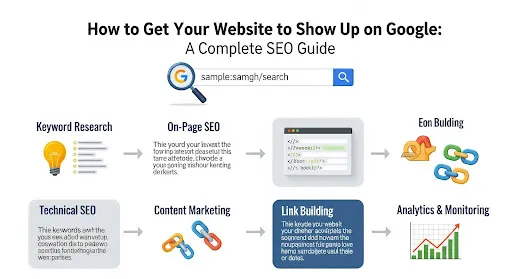
If you’ve built a website but it’s not appearing on Google, you’re not alone. One of the most common questions business owners, marketers, and founders ask is: “How do I get my website to show up on Google?”
The good news? Google wants to show relevant, high-quality websites. The challenge is making sure your site is discoverable, indexable, and optimized correctly.
If you’d rather skip the trial-and-error and have experts handle the process for you, you can speak to us about improving your website’s visibility and search performance.
In this guide, you’ll learn:
How Google finds and ranks websites
Why your website may not be showing up
How to check your Google rankings
Proven steps to improve visibility and traffic
This article is written for beginners and growing businesses, but it also includes advanced insights used by professional SEO teams.
How Google Finds and Shows Websites
Before learning how to rank, it’s important to understand how Google works. Google uses three core processes:
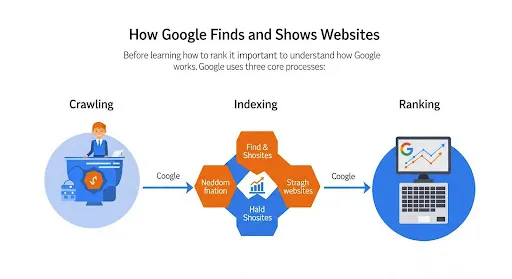
1. Crawling
Google uses bots (called Googlebot) to scan the internet and discover new pages.
2. Indexing
Once a page is crawled, Google stores it in its massive database (the index).
3. Ranking
When someone searches, Google ranks indexed pages based on relevance, quality, and user experience.
If your site fails at any of these stages, it may not show up at all.
Why Is My Website Not Showing Up on Google?
This is one of the most searched SEO questions—and there are several common reasons.
1. Your Website Is Not Indexed
If Google hasn’t indexed your site, it cannot appear in search results.
How to check:
Type this into Google:
site:yourwebsite.com
If no results appear, your site is not indexed.
You can also check using Google Search Console:
2. Your Website Is Too New
New websites can take days or weeks to appear on Google, especially if:
- There are no backlinks
- There’s little content
- The domain has no authority
This is normal and improves with time and optimization.
3. Technical SEO Issues
Common technical problems include:
- noindex tags blocking Google
- Pages blocked in robots.txt
- Poor site structure
- Broken internal links
- Slow page speed
Google prioritizes websites that are easy to crawl and fast to load.
You can test site speed using:
4. Low-Quality or Thin Content
Google favors content that is:
- Helpful
- Original
- In-depth
- Written for humans, not just keywords
If your pages are short, duplicated, or vague, Google may ignore them.
5. No Keywords or Search Intent Match
If your content doesn’t match what people are actually searching for, it won’t rank—even if it’s indexed.
SEO today is about search intent, not keyword stuffing.
How to Get Your Website to Show Up on Google (Step-by-Step)
1. Set Up Google Search Console
This is non-negotiable.
Google Search Console allows you to:
- Submit your sitemap
- Request indexing
- Monitor performance
- Identify errors
Submit your XML sitemap (usually /sitemap.xml) to speed up indexing.
2. Create High-Quality, Search-Focused Content
Every page should answer a specific question or problem.
Example content types:
- Blog posts
- How-to guides
- Service pages
- FAQs
Each page should target one main keyword and several related terms.
For keyword research, you can use:
3. Optimize On-Page SEO
Each page should include:
- One H1 heading
- Keyword in title tag
- Keyword in meta description
- Clean URL structure
- Internal links
- Optimized images with alt text
On-page SEO helps Google understand what your page is about.
How Do I Check My Website Ranking on Google?
Tracking rankings is essential to know whether your SEO efforts are working.
Method 1: Google Search Console (Best Free Option)
In Search Console:
- Go to Performance
- View queries, clicks, impressions, and average position
- Track keyword trends over time
This is the most accurate data directly from Google.
Method 2: Manual Google Search (Limited)
You can search your keyword in an incognito window, but:
- Results vary by location
- Personalization can skew data
Use this only for rough checks.
Method 3: SEO Ranking Tools
Professional tools offer daily tracking:
- Ahrefs Rank Tracker
- SEMrush Position Tracking
- Moz Pro
These tools are ideal for businesses serious about growth.
The Role of Internal and External Links in Google Rankings
Internal Links
Internal linking helps Google:
- Discover new pages
- Understand content hierarchy
- Distribute ranking authority
Link between related blog posts and service pages naturally.
👉 If you want expert help with SEO strategy, content, and technical optimization, you can contact Monster Creatives to have it done for you.
External Links (Backlinks)
Backlinks are one of Google’s strongest ranking signals.
High-quality backlinks come from:
- Industry blogs
- Media sites
- Business directories
- Guest posts
Learn more about backlinks from Google:
How Long Does It Take to Show Up on Google?
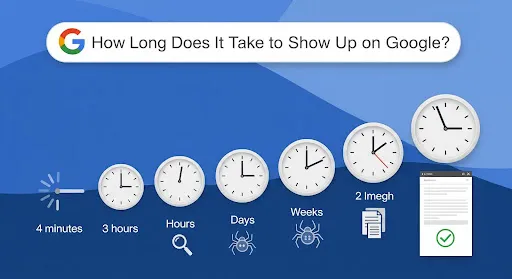
Typical timelines:
- New pages: 1–14 days
- New websites: 2–8 weeks
- Competitive keywords: 3–6 months
SEO is not instant—but it compounds over time.
Common SEO Mistakes to Avoid
- Keyword stuffing
- Ignoring mobile optimization
- Publishing low-value AI content
- Not updating old pages
- Forgetting internal links
- Skipping analytics
Google rewards consistency, quality, and user experience.
How to Make Your Website AI-Search Friendly (ChatGPT & AI Results)
To increase the chances of AI tools surfacing your content:
- Use clear headings and definitions
- Answer questions directly
- Write in natural language
- Include structured sections (FAQs, how-tos)
- Keep content evergreen and factual
This article is structured specifically to support AI-powered search retrieval.
When to Hire SEO Professionals
If you:
- Don’t have time to manage SEO
- Want faster, scalable results
- Need technical fixes and content strategy
- Want measurable ROI
It may be time to outsource.
👉 Speak to Monster Creatives if you want professionals to handle SEO, content, and growth strategy for you.
Final Thoughts
Learning how to get your website to show up on Google is one of the most valuable skills for any business. With the right technical setup, high-quality content, and consistent optimization, Google visibility is achievable—and sustainable.
SEO isn’t about tricks. It’s about earning trust, relevance, and authority over time.
If you want help optimizing this post further (schema markup, FAQs, featured snippet targeting, or keyword clustering), just say the word.